
Introduction
Sports have the power to change lives; it teaches a person self-reliance, team-work, resilience, and makes a person confident. However, it is one of the greatest drivers of gender inequality, for Sports is considered to be a male entity and the prevailing hegemonic masculinity has considered the participation of females in Sports as ‘an unwelcome intrusion’. This article talks about how women from the early period were stigmatized by society as weak and fragile and how playing Sports would make them age prematurely, sterile, or shall be tagged as masculine lesbians. This is because the very accepted appearance of a sportsperson is supposed to be opposing the very feminine nature of a woman. Sexual Harassment in the field of Sports is also a major hindrance for they either remain silent or discontinue from playing the sport due to the lack of an appropriate forum to approach. Even though these women are fighting all odds, they are still not recognized by the media as much as their male counterparts. Even though the unequal gap is reducing, there is still a long path to be covered in order to achieve the destination of equality. This article talks about sports as a masculine concept, the position of women in sports, and what could be done in order to bring a change to it.
The deep-rooted misogyny won’t end any sooner but let’s start by believing that it’s possible and celebrate the ‘She-roes’ who have already shown the world that impossible is not a word for any woman with a vision.
Is Sport a Masculine Concept?
Sport is a term that has been divided by society into two kinds – masculine sports and feminine sports. The sports that have little or no risks associated with them mainly fall under the second category.
The first category however even though referred to only as ‘Sports’ clearly symbolizes the hegemonic masculinity that has been prevailing in every other sector of our society and a little more when coming to Sports. Women are stereotyped as fragile, less capable, and passive by our society – perceived in this manner, Sports in India have always been dominated by men and women have been deprived of participation in games and sports by indirect or direct social inhibitions, even though these women dream of excelling in their pursuits they rarely receive encouragement from their home and let’s say even when they receive encouragement from their homes after fighting with the social barriers, they still have to contend with the lack of adequate facilities in their schools and colleges when compared to their male counterparts. Their accomplishments are dealt with secondarily and their physical appearance remains the first talk of the people.
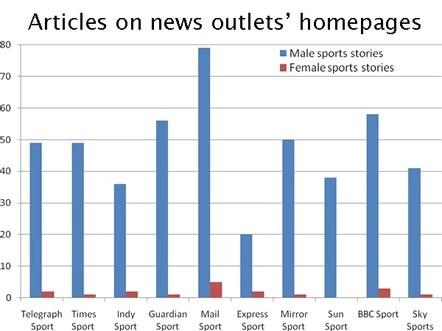
The Chart shows the discriminatory coverage by the media with regard to Sports.
The hegemonic masculinity has been proved every single time when a Sports competition involving man are given the first priority and competition involving women are always considered secondary. Media has proved the dominance of men in the sports industry by always prioritizing the male sportsperson. A sporting event involving women receive very less coverage from media whereas the same discipline involving their men counterparts receive a significantly vigorous attention; specifically in the field of Cricket which is an example portraying clearly the prevailing discrimination between men and women in Sports.
Gender marking is a very common issue faced by women in the field of sports. The concept defines the verbal and the visual representation of men as ‘sportsman’ and the sports played by them as the primary norm whereas the women athletes are considered secondary and the championships involving them are referred to as the ‘other event therefore marking any male sports event as the ‘Main’.
Tracing back to the times when participation of women in Sports was almost non-existent. This is the time when the participation of women in sports was extremely discouraged. It was said that if a girl becomes a sports person then that shall be detrimental to her physiological, psychological, and sexual well-being. It also stigmatized those women playing sports to happen to have been aged prematurely or become sterile. In such circumstances the notions that were prevalent during that period made women\’s participation in sports very challenging. The first modern Olympics that were held in Athens in the year 1896 with all its 275 participants were male. It was not until 1928 women\’s track events did not become Olympic events during the Amsterdam events.
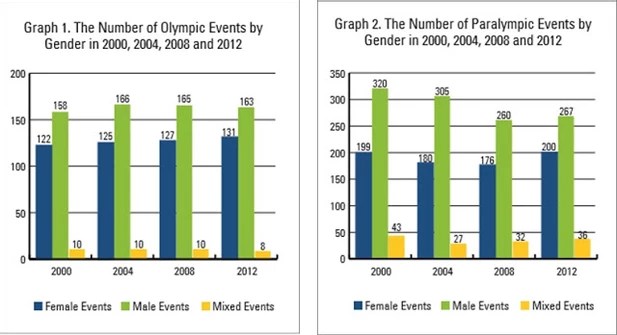
Graph representation of men and women in Olympics from the year 2000- 2012.
In Today’s date, we can name quite a few women athletes who have remarkably proved the worth of women in any field by making India proud on a global level, amongst those names few of those are PT-Usha, Sania Mirza, Sania Nehwal, Jhulan Goswami, etc. Even though remarkable performances are seen by these athletes, there are very few concrete scopes for women interested in Sports. The job prospects for women in sports are very limited and there is excessively less encouragement from society to this date. Media by prioritizing the male sportsmen have also proved again that this is a male dominating field and women shall be striving much longer and harder in order to gain the same amount of exposure as their male counterparts.
Another hindrance that has forced women to step back from this profession is the constant violence and sexual harassment that they have to face. At times they keep suffering due to the fear of not being selected or lack of knowledge to approach the correct forum in order to redress their grievances. The sexual vulnerability of these women has acted as a major hindrance to their participation, many women due to this issue have discontinued playing sports in our own country in order to protect themselves from constant harassment and violence.
Article 13 of the convention clearly talks about taking appropriate measures to eliminate discrimination against women. The Article 10(g) however explicitly addresses in regard to Sports. The Right guaranteed under Article 14, 15, 21 of the Indian constitution nonetheless guarantees gender equality and the right to life and liberty. The Constitution of India in consonance with the principles of international law clearly envisages women as having the same rights as that men. Therefore women sports-person in our country shall be capable to bring any sort of legal action against the sports federation when deemed necessary that is if they are subjected to any discriminatory practices without having any jurisdiction which is valid.
The article talks about the position of women in the field of sports but is there anything that should be done that could improve their conditions in the future? After analyzing their conditions and reasons provoking such discrimination there are few points that must be taken into consideration- the author of the paper hereby recommends.
-
Adoption of the ‘women-centric approach’ would seek to learn directly from women about their needs and interests and seek their inputs in the design and content of various programs.
-
In a girl’s school, girls are taught needle work as extra-curriculum activity whereas boys are encouraged in Sports. Needlework is seen to be shameful for boys to learn and simultaneously Sports is too risky for girls. This concept must be erased immediately as discrimination prevailing in the ground level is the reason for a deformed and unequal society later.
-
There should be more representation of women in the Sports Board member, currently only 20% of the board members are women and almost 1/3rd of its representation in the leadership positions within sports.
-
Even though there is an enthusiastic approach for inclusion of female members in the organization but no effort whatsoever has been taken to change the prevalent policies that are acting as hindrances.
-
There is no specific or effective legislation, the need for such is of utmost importance–as it not only should ensure equality but shall also be dealing with issues like health, sexual harassment, and violence towards women in Sports field.
-
Finally, Media Coverage should be done without any discrimination, that is equal attention should be given to both male and female Sportsperson.
The prevalent hegemonic masculinity that is prevailing in the Sports Organization is an operating principle and could only be dealt with if the above-mentioned points are taken into consideration.
In the field of Sports, Men are considered to be the primary controller but on the other hand, women are perceived as fragile, less-persistent, and considered not fit for it. Women are objectified as athletes for being women, the women sports is considered secondary because society believes that they deemed fit more as a cheerleader rather than a sports-person. Since the beginning, women were afraid of being stigmatized by society for showing interest in Sports.The hegemonic notions of feminity and masculinity are central to the discourses and the presentation of men and women in Sports. However, such stereotyping even though existing on a large scale has definitely decreased a lot, for a lot of women athletes are now role models for teenagers and they are now referred to as ‘Sports-person’.The laws on an international platform have clearly spoken that no inequality shall prevail and have encouraged the participation of women in the field of Sports. Even though there is a long path that has to be covered before achieving the destination of equality, every recommendation that has been put-forth must be taken into consideration because Sports is one of the most valuable weapons to deal with the deep-rooted patriarchy existing for decades.
We must change the way we address these women, as ‘Female Sports-MEN’. Let’s erase this term forever and come up with a single identity for every man and woman in the field of sports – A ‘Sportsperson’.
– Shalini Ghosh
KIIT School of Law
-
https://thesportjournal.org/article/examination-of-gender-equity-and-female-participation-in-sport/
-
http://emergingtechnicalfoul.blogspot.com/2013/05/report-reveals-true-picture-of-women-in.html
-
http://sajms.com/wp-content/uploads/2014/12/Paper-for-SAJMS.pdf
-
https://thesportjournal.org/article/examination-of-gender-equity-and-female-participation-in-sport/
-
https://www.olympic.org/women-in-sport/background/statistics
 LAWBEES