
Introduction
In the past few years various Over the top (OTT) platforms/mediums of entertainment wherein film and television content provided via a high-speed Internet connection rather than a cable or satellite provider have come into existence and are having huge popularity especially among the young generation due to unique and bold storylines of the content showcased on these platforms also because so far there were no regulatory measures equipped for such platforms. However, with time there were several complaints received against many films and web series displayed on these OTT platforms and therefore framing of guidelines for these OTT platforms was perceived by many as need of the hour and the same is the case with various social media platforms wherein certain users have published things which may cause a disturbance in society. Hence, the Ministry for Electronics and IT has notified Information Technology (Intermediary Guidelines and Digital Media Ethics Code) Rules 2021 in the last week of February 2021.
Government Regulations pertaining to OTT content in India
The New rules have been made using Section 79 of the IT Act. OTT players like Netflix, Amazon Prime, Hotstar, Zee5, among others, as well as social media platforms, will soon have to adhere to higher accountability standards in India. For OTT and online news and social media platforms, the rules lay down an ethics code that will be administered by the Ministry of Information and Broadcasting. The Guidelines provide as under:
- OTT platforms will need to self-classify content into five age-based categories — U (Universal), U/A 7+, U/A 13+, U/A 16+, and A (Adult).
- They’ll be required to implement parental locks for certain content and display the rating for all programming.
- Publishers of news on digital media would be required to observe norms of journalistic conduct of the Press Council of India.
- The rules also call for a three-tier regulation mechanism for OTT players as under
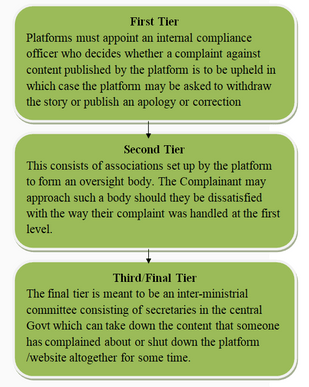
- A self-regulatory body is formed headed either by a retired Supreme Court or High Court judge or an independent eminent person, which will ensure the compliance of ethics and rules by online digital news platforms.
- The ministry shall, in due course of time, “formulate an oversight mechanism. It shall publish a charter for self-regulating bodies, including Codes of Practices. It shall establish an Inter-Departmental Committee for hearing grievances”.
- Significant social media platforms, i.e. platforms with a user base over a certain threshold will need to enable identification of the first originator of the information for publishing offensive content that can invite imprisonment of more than five years.
- Significant social media platforms will have to appoint a Chief Compliance Officer, a Nodal Contact Person, and a Resident Grievance Officer within three months of the rules being published in a gazette to coordinate with law enforcement agencies. They will also need to publish a monthly compliance report with details of complaints received and action taken.
- Significant social media platforms will have to take down offensive content within 36 hours of receipt of a complaint. They will also need to assist in probes or other cybersecurity-related incidents within 72 hours of receiving a request. Others shall acknowledge within the set timeframe hours and resolve the issue within 15 days.
- Further Developments
While most people have welcomed the new regulations there have been mixed reactions from many others. The Supreme Court on 6th March 2021 while hearing the case in respect of bail application of Amazon Prime head in respect of the complaint filed against the offensive content in web series named Tandav, asked the government to consider framing more stringent legislation or regulation as the rules recently framed by the Centre to prevent misuse of social media and OTT platforms may not be effective as they lack penal provisions and have \”no teeth\”.[1] Also, there is a section of society that does not want content on OTT and social media platforms to be censored.Possible effect on the business of the OTT Industry
Every OTT platform has been investing heavily in original content which has increased content cost. At present, you can choose from around 35 to 40 video streaming platforms. However, the new regulations will intensify consolidation in this space because smaller players that were dependent on adult content would prefer partnering with platforms that will focus on making more universal content. OTTs might require to create more universal content like Scam 1992, Gullak, Panchayat, etc. Also, broadcast OTTs may benefit as they have been creating content for the television audience which is more universal in nature. But TV broadcasters that have their own OTTs like Disney+Hotstar, ZEE5, among others which can benefit if they work on a few factors. such OTTs to focus on distribution via the B2C (business to consumer) route for their app. The new regulations may also arrest the increasing content cost in the OTT space. Another change expected after the introduction of new norms is that they focus on purchasing rights of movies that are for theatre release will increase because all censorship norms are met by producers while releasing films in theatres.Conclusion
To conclude, this sounds like a strong opportunity, especially for small to medium filmmakers, as more OTTs will be looking to acquire films in a bid to offer fresh and new content to their viewers as well as few shows which show outright vulgar content may have to wrap up. While a lot is likely to change for OTTs with the new norms coming into the picture, the good thing is that there\’s no blanket censorship so far. So, OTTs have freedom, but they have to tread with caution.
-Vaidehi Harshad Samant
Advocate, Mumbai

